The decision to go to India was really last minute. My
overland trip organised by
Dragoman (from Kathmandu, through Tibet and into
China ending in Xian) had been cancelled. The Chinese government closed the borders
to foreigners apparently because of a self burning protest by some monks in
Lhasa. The trip had been organised at least 10 months ago, and was the
middle, and I felt pinnacle, of my trip so I was really devastated about it
being cancelled at the last minute (six days before flying to Kathmandu) and
made me want to spend time in China even less. I had a six month visa for India
which I got back in January when I was still in London (why didn't I get it en
route when I knew when I was going to be there exactly is one of the big fails
of the trip) so as it turned out I only had one month left on the visa when I
went there. I thought I’d spend a month there, then a month in Nepal and a
couple of weeks in China before my Trans Siberian train to Moscow.
India was one of the only places that I was a little scared
of going to. It was midsummer and on the brink of monsoon
being June, and so would either be scorching hot or intensely wet, or both. I
was going to be alone again and I’d heard that it was strange to some Indians to be a women travelling
on her own, and so treated them weirdly. Besides all the amazing things I'd heard, and knowing deep down inside that I'd love it, I’d heard stories of staring, groping and just general
uncomfortable behaviour from men there so I did have that in the back of my mind. But I was still dead excited to be going overall.
It’s such a vast place, I had to think about where on earth
should I go and what to do. I met a really cute couple in Pai Thailand, Micky
and his girlfriend, and they had been to North West India and told me about Manali and
Leh up in the mountains where it’s cool away from the mid summer heat. I’d heard about
North West India from a few other people too, Dharamshala, Shimla, all up in
the mountains which is what I craved. So I made plans to go straight to Leh
Ledakh from Delhi. I was nervous, excited and felt exhilarated to be going to
the Himalayas and to do some ‘real’ travelling, leaving the Western comforts of
SE Asia behind.
I overstayed my Thailand visa by three days and had to pay
500 Baht a day fine (£30 in total). I think you can overstay up to three weeks
and they hardly bat an eyelid, after all it’s a comfortable money maker and all
you get is a tsk and something to sign. I had already raced to the airport from
the Mongolian Embassy after getting my visa and really cut it fine with dealing
with the overstay paperwork, but somehow I got through it all without much
hassle (always take the Skytrain to the airport in Bangkok, it’s a tenth of the
price of a cab and is so much quicker and more comfortable) and was at my
terminal in time to study all the people boarding the flight. They were all
Indian, and it was interesting to see this little microcosm of India in a
pocket of Bangkok airport. Starkly different from their environment, emanating
their own strong culture. I got a few ‘western girl on her own’ stares, and
sighed as I hadn’t even left Bangkok but thought it was good practice anyway. I
flew with Indigo Airlines, an Indian budget airline which have new shiny
planes, competent pilots and are probably one of the best budget airlines I’ve
flown with, I can recommend them. The flight was only four hours, so short I
couldn’t believe it. Delhi and Bangkok, separated by a thousand differences and
only four hours of sky.
Arriving in a new country is always a little jarring and
unnerving, especially if it’s by air as you aren’t allowed the comforts of the
gradual change of landscape and people. You’re plucked from one almost familiar
place (which you’re more apprehensive to see behind you because of the effort
and time it took to get the feeling of familiarity) and plopped in new strange
land. Arriving in Delhi airport was the only time I felt properly nervous, and
had no idea what to expect. I knew not to look baffled, to find out all the
details of transport or accommodation slowly and calmly so as not to get
scammed or mobbed by touts. I wasn’t in the new terminal 3 of Delhi airport,
which could be in Singapore or Hong Kong with comfortable seating and floors of
shops and places to relax and eat. I was in old terminal 1, which had musty
carpets and felt like one long corridor with one coffee shop, and I could see
guards ready to poke anyone with a stick who decided to have a snooze on the
floor waiting for their next flight. I arrived at around 4pm and my flight to
Leh was at 5am the next day. I decided to treat myself to an airport transfer
hotel, much more expensive than a hostel but much closer to the airport and
easier to arrange. The city centre was really far away, and getting a taxi
there and back, finding a guesthouse in crazy Delhi central and then having to
wake up at 3am didn’t appeal to me one bit. I went to the hotel desk and spoke
to the two men there, who assured me of a very good hotel, 2000 Rupees (Rs) £22
but I had to pay for my own taxi there for Rs 450. (They insisted, it must be air conditioned, you can’t go in
a local taxi it’s too hot. Of course you can go in a taxi with no aircon, just
open the windows. It won’t kill you) It was so steep, much more than I’ve ever
paid for any hotel on my entire trip, but I just wanted somewhere safe and
clean to get my head around the place.
It was scorching in Delhi, around 38 degrees. The taxi drove
through the big, dusty butthole streets of the areas surrounding the airport,
and dropped me at my hotel which looked crumbling and uninspiring; I couldn’t
believe I had spent so much money on it. There were only men around. Men
working at the counters at the airport, men driving taxis, men travelling, men
in the hotel reception, male porters, male receptionists. It made me stand out
even more and made me so uncomfortable, where the heck were all the women? But
I held my ground and had a chat to the receptionist and the only other Western
person there, a German. I thought about taking the metro into central Delhi but
I was still coming to grips with this dusty hot place. I was
shown to my room which was fancy with a TV, the only nice thing about the
hotel. There wasn’t even any little local places to eat or shops to look at
outside, just a big concrete flyover and dusty, loud streets leading off the main
highway to the airport. So I decided to eat in the hotel, with the German I met
named Harold. We were the only two people in the hotel I think, well the
only ones who ate in the overheated restaurant. It was my first Indian curry in
India (I really love Indian food) and it was yum. I was a little nervous of my
tummy and all the scary things that I heard could happen to it in India, but I
ate everything anyway. One big plus about North India, its mainly vegetarian.
We had a warm beer that the waiter had to fetch from somewhere hidden (there
isn’t any alcohol in the restaurants in India, another good thing) and talked
about Harold being the head chef in posh hotel in Germany and how he quit to
travel in India.
It was a weird night of loud air-conditioning, people
knocking at my door really late (why I don’t know, I didn’t answer) and shouts
from some late arriving guests. I had to turn the air con on and off as it was
too loud to sleep, and the tap dripped so loudly that my earplugs didn’t block
them out. I was happy to get out of there at 4.30am and get the cab back to the
airport. When booking the hotel room, after a very lengthy negotiation they said the return cab to the airport was included but when I got
to the desk the new guy asked me to pay for it. If you’ve ever seen Blackadder
II with Queenie, you’ll understand what I mean when I raised an eyebrow, swung
on my heel and said a high pitched and unequivocal ‘NO’ and climbed in the
taxi. It felt like everyone is trying to make a little extra cash from confused
and overwhelmed foreigners, so hold your ground.
The flight to Leh was truly spectacular. It was on a clear,
breathless morning arriving at around 6:30am. Around Delhi it’s completely
flat, and then the hills start appearing and the ground looking more knobbly.
And then, after around 40min, so suddenly it makes you catch your breath, the
Himalayas begin. They are so high (some 7km high) that it feels like the
plane has dropped a few thousand feet as the ground seems so much closer, but
its only because the mountains are almost (it feels like) touching the bottom
of the plane. Honestly one of the most exciting moments of my trip. Mountains!
My heart leapt out my chest.

The plane did so many turns as it came down to
land after only an hour, and it was thrilling to see it weaving in and out of
the mountains. It was a perfectly crisp, clear day in June and everything was
visible... the lakes, the houses, the trees and every crease and fold of the
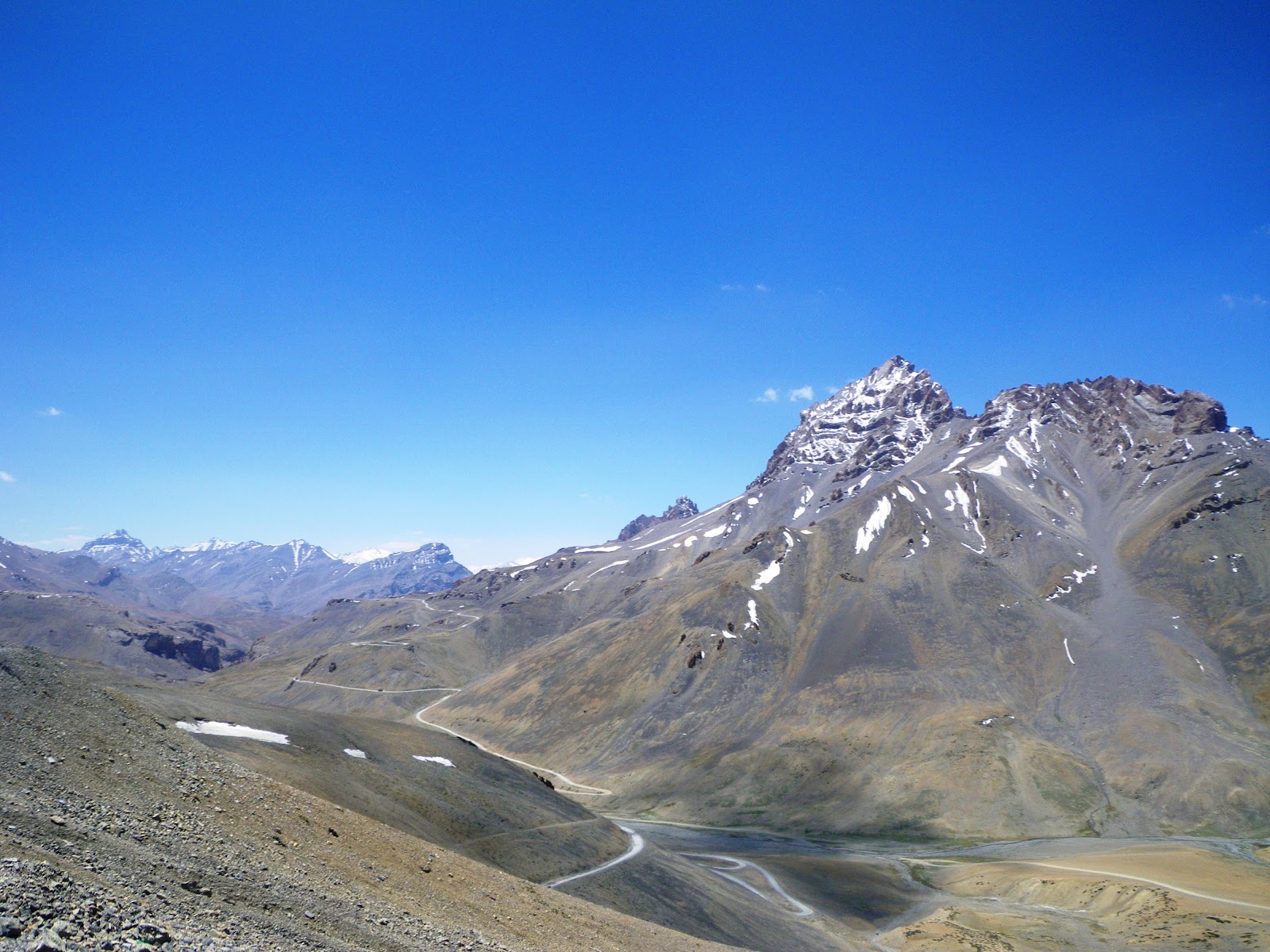
mountains. The landscape was very arid with brown/grey rock, and it looked like
we were landing on the moon. Many people refer to Ledakh as a ‘moonscape’. The
towns were green with trees though, thanks to the hundreds of years of manmade
irrigation that these industrious mountain people have cultivated.
I got out
the plane and it was crisp, a bit cold (so relieving after Delhi! ) and the
air thin and pure. The airport is tiny and looks like the waiting room of a
small local bus station. There were armed police or soldiers patrolling, a
reminder of some of
the conflict in the area. There is a big army base here.
I had been dropped smack in the middle of the Indian
Himalayas which I reminded myself of when walking out the airport. The
mountains in this part of the world are majestic, immense, all absorbing, and
they’re laid out all around you like a landscape painting conjured up in a
dream. The highest road pass in the world is in here (5600m) around 1000m than
the highest mountain in the Alps, Mont Blanc. If there’s any bad weather like
fog or clouds, which there is a lot of, planes can’t access it as they can’t
see the huge mountains that they could potentially slam into while making all
the hair raising twists and turns when landing. The roads are practically cut
into the side of the mountains and some are paved, but mainly it’s a carpet of
rocks and ditches and boulders and insane
twists and bends complimented by sheerest cliff drops on one side you’ve
ever seen. They are often closed because of rain/snow/landslides. (More on the
road to Manali to come later).
Leh is a town amongst all the moonscape, the biggest in this
huge area. It was just starting to fill up with the foreign and Indian tourists
wanting to escape the heat down South. I got there just before the heaving
tourist season, and I was glad as usual because places off season are quieter,
cheaper and more natural. I found a cute place called Peace Guesthouse which
was smack in the centre but tucked away with a nice quiet garden. I decided to
treat myself to a nice room with my own bathroom to help acclimatise to this
brand new place and very high altitude. It cost Rs400 a night.
 |
| Leh |
 |
| Leh high street |
They say you
can’t do anything the first couple of days when you go straight up to high
altitude (3500m) and they’re right, try running up the stairs or even walking
up a hill it’s very difficult. I went straight to sleep when I got there at
around 7am, got up and had something to eat and explored a bit, went back to
sleep, got up again for another walk, then went back to sleep again. The first
day I was there, it felt like four days because I kept on sleeping. It was cold in the shade and nice and hot in
the sun, and the light was very bright and crisp and the air just, well just
glorious. I was in India but didn’t feel like ‘real’ India as it’s more similar
to Nepal or Tibet in culture, scenery and religion.
Toward evening I was sitting in a cafe and saw a girl
sitting alone at a table who looked interesting and I felt like a chat, so I
went over to her. Her name is Tamar, from Isreal and just out the army where
she worked as a journalist. I was soon to find out that there were thousands of
Isreali’s travelling in India, especially in this area. I had no idea that so
many of them travelled here, I was told that after the army it’s where the
mostly travel to. Tamar was doing some seriously hardcore travelling (way more hardcore
than me) exploring villages in remote India where she didn’t come across
another English speaker or foreigner for days at a time on her own, and
hitching rides from the crazy Indian trucks, she hitch hiked with two friends
from Kashmir to Leh way up North. I was really glad I decided to talk to her,
cool chick like mad! We had dinner at the Chinese Bowl on Changspa Road (good,
cheap food and the place I ended up eating at the most in Leh) and she
explained to me the Indian dishes and teas, it was still only my second day in
India although because of lack of sleep and how long it took to get there it
felt like ten. Her friends that she was travelling with joined us; Max from
Germany and Jim from New Zealand.
 |
| Tamar, Jim, Max |
I wanted to go on a trek for a few days into the mountains,
but didn’t want an organised tour or to pay for an expensive guide (ballpark
charge for them around Rs2000 a day). I wanted to go off with some good people
who kind of had a good idea on the area and were confident just heading into
the mountains, and who knew the practical stuff we needed and stuff like
transport. I felt like going a proper adventure into the wilderness. I asked
Tamar and her friends if they knew anyone doing something like that in the
coming days, and she told me about Avi, also Isreali, who was planning
something. I met him that night, he seemed pretty hazy about his plans but I
really wanted the adventure so decided to go along, but had to wait a few days
to get used to the altitude. So I spent the next couple of days with Tamar
going to some morning yoga classes, climbing up to the monuments dotted around
the mountains and having some walks around town.
 |
| Walking up to the fort |
 |
| Kids playing football |
 |
| Lots of spiritual books at the yoga centre |
Leh really was different to everywhere else I’d been. I
don’t know if it was being in India, being in such high mountains, the air
being so different and the culture but I felt renewed, my head felt clearer and
I felt very calm there. Alcohol isn’t widely available, you can get it but it’s
very expensive. So you just drink tea, yum masala chai or fresh mint or fresh
ginger and lemon.

It really cleans you out. And the food is so good, Indian food has always been a
favourite and you can walk into any local dabba (food stand or small room with
chairs and a stove) and eat like a king for nothing, less than £1. All
vegetarian, all fresh. Soft floury roti’s made over a hot stove straight on the
heat that melt in your mouth, vegetable thali’s with delicious healthy dahl,
spicy potato curry, juicy flavoursome samosas.
You can still find Western style restaurants that aren’t that expensive,
but the best food is where the locals are. Just ignore everything that you
wouldn’t see eating out in the West (dirt is your friend) and tuck in. I ate at
plenty of dabbas and didn’t get sick once, besides also drinking out of rivers
and river pipes in the Ledakh Himalayas, the water there must be cleaner than
in London although I think I was lucky with a hardened stomach not to get at
all sick.
After around four days I was very ready to go on a trek. I had acclimatised and felt really
good, super healthy and energetic and anxious to get out into the mountains.
Tamar told me she remembered another Israeli friend of hers, Ido, talking about
a remote village that he’d seen briefly a few days before and that he was going
again soon. It sounded more than perfect for me, so she sent him a message. I
had met another traveller, Vincent who was French Canadian, who wanted to go on
a trek too so that night we went out for some food. When Tamar arrived she
walked up to us, but walked straight past us to the next table and laughed, Ido
was sitting there with his father the whole time while we had been talking
excitedly about the possibility of the trek and wondering if he would get back
to me. So we joined tables and made the plans. I couldn’t have been happier,
going to a remote village in the mountains a few hours trek from any road for a
few days and not having to worry about anything as he had been there before and
knew the way, and knew it was
somewhere very beautiful and special. Lucky me!
The next day we met up and he introduced us to Gayla, a girl
he had been volunteering with in Nepal who he had bumped into randomly and who
wanted to come with us too. We bought some supplies like cashew nuts, dried
fruit, a pot for making coffee. Ido had some real ground coffee that his dad
had brought from Israel that was such a treat. It was fun to wander around the
local markets looking for stuff. Even though Leh is quite touristic we still
got some stares having tea with the local dudes at a chai shop in the local
market area. We had a hearty breakfast the next morning, salty beans with thick
chunky brown bread and coffee, and then set off in the rain to find the local
bus station. It wasn’t hard, and we were straight on a friendly bumpy bus wet
from rain but excited for an adventure.
 |
| Buying nuts |
 |
| Hanging in the local marketplace |
 |
| Gayla and Ido with chai |
I’ve heard a few people refer to Ledakh as a ‘moonscape’ and
it really is. Its mountain desert, huge valleys and tall mountains and steep
cliff faces with a river, and everything covered in stones a whole spectrum of
greys and browns and even greens and blues. The vastness and scale of the place
is something I’ve never seen before, just a continuous stretch of rock and
river. The bus went on its windy route, going up and up and then twisting round
and round, sticking to the river. Every village passed was a small green oasis
made possible by century old irrigation canals, water that climbed up hills and
around corners to feed the small rice paddies. In some places the road
disappearing and becoming rocky ditches that the bus ploughed through. It made
a short stop for chai drinking, and then it was off again along the mountain
road, screeching to a halt every now again to let someone off into the rocky
wilderness (where were they going? Not a house to be seen) or to pick people
up. All the instructions to stop or go given by a secret language of whistles by
the ‘conductor’ to the driver.

We bumped and twisted for a few hours, ogling at the desert
mountain scenery. Eventually Ido saw the bridge we had to go across and so we
got the guy to whistle, and piled out onto the road excitedly. There were
workers all along the road, painstakingly breaking up the big rocks fallen on
the road from landslides. The bridge didn’t look like it was leading anywhere
except towards a mountain side, but there was a small crack that we made our way
towards, and there was a barely noticeable rocky path, with another tiny bamboo
bridge over a fast flowing mountain river. We waved goodbye to civilisation and
began our trek to the village.


The path was used by the village people and so was well
maintained, with bridges old and new over all the furious little streams that
were flowing towards the big river behind us. The snow was melting now, and it
was starting to be raining season so this was the time for them to really flow.
It was a beautiful walk, in between the multicoloured rocky cliffs. It was all
rock and river except every now and again there was a bright green glade with
summer flowers blooming. Every step took us away from the road, and it felt
great. There was no road through here; the path of a couple of hours was the
only way there. You could imagine the village people in this area carrying
absolutely everything they needed a few hours on their backs.


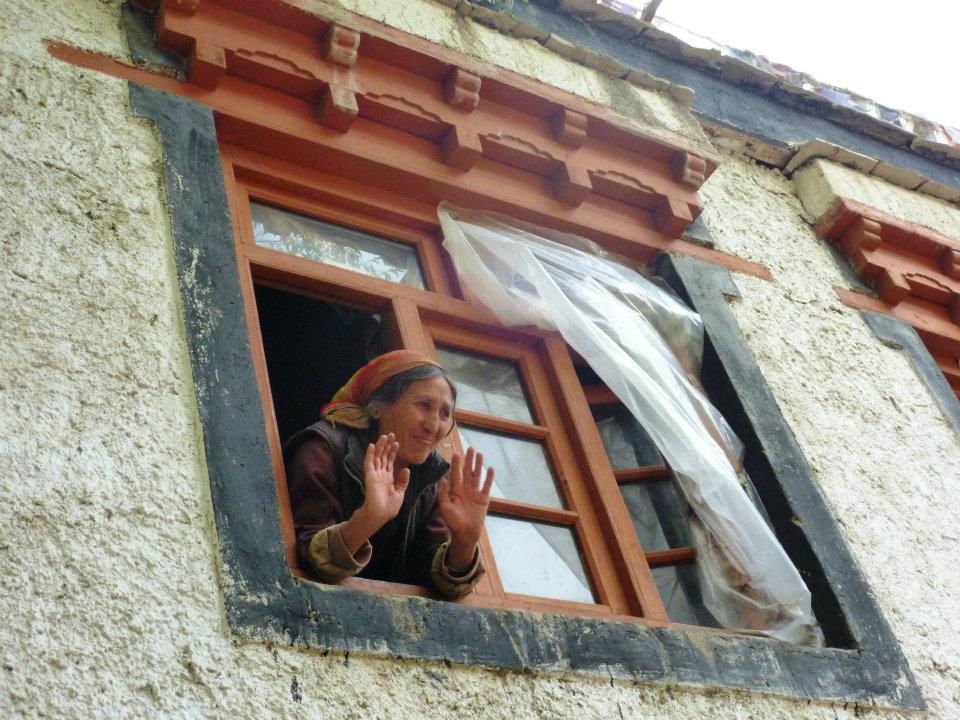
While walking we
saw a small stooped granny in the distance, but she caught up to us in no time.
She was dressed traditionally but had trainers on, and offered to carry our
bags for us when she saw us huffing! She went on in front and called out to us
every so often to make sure we were okay and could keep up. After climbing a
few stone stairs we found what we were looking for, a valley opened up and we
were in honestly the most beautiful place I had ever seen in my life.
 |
| First view of the village and house we would stay in |
The granny invited us in for tea, she had done the same
thing in for Ido when he came with his father a few days before. She was a feisty
bright spark, strong and bustling around. She gave us some tea and homemade
chunks of bread and biscuits, and even though she couldn’t speak hardly any
English she entertained us until she clearly had enough, and told us abruptly but
sweetly that it was time for us to go. So funny.
 |
| The wonderful granny who invited us for tea - Ido's pic |
We knew there was one house in
the village that had been trained or certified to host guests, and we set off
to find it. It had started to rain by this time and it had been a long journey,
so when we saw the house and a small elderly man standing outside it we couldn’t
wait to get inside. He ushered us in to this beautifully simple, comfortable,
traditional mountain home, into a room with four mats along the walls, some
small tables and some thick comfy blankets. We could not have been happier to
go into this cosy small room in this home in a village in the middle of the
mountains. He smiled at us and came to investigate us even though he couldn’t
speak English, and when his daughter came home she stuck her head in the door, ‘Julay
Julay!’ (Welcome), and quickly went out in a bustle to pick veggies from the
garden while her elderly (who I named Papa) father went out to chop wood for
the stove.
 |
| The house |
 |
| Papa cutting wood |
 |
| Investigating my ukulele |
I’m not sure how many people just turn up out of the blue
like we did, but from what we could find out with limited English is that it
was around ten people that year. There had been a woman there called Cynthia
who was a bit of a legend. From what we could glean, she had showed up on her
own in winter and had stayed a few weeks, in a tent on the mountain side. I’m
not sure what she did there for a few weeks, but it seemed that all the villagers
knew her and spoke of her. She had brought small gifts for them like thick
socks, and every now again we’d point at something and they’d say ‘Cynthia!’. We
spent that first afternoon huddled in the room away from the cold and rain, and
then were called into the main living room for supper. They had made us an delicious
meal of momos, freshly made. The room was big and warm and on one side there
were shelves of shiny cooking pots, and a wood stove that warmed everything up
and was the main cooking area. Along the sides there was a seating ledge, and
Papa had made himself a comfortable corner with a table, his book and glasses
and prayer wheel, which he concentrated on after we ate.
 |
| Pulma cooking in the main room, with old fireplace |
 |
| Sitting, Papa in the left corner |
They were so sweet and
friendly with the small amount of English they knew. They welcomed us into
their home with no reservations, and even though this was clearly an income
source for them there was no discussion of money, charges, or any other
questions at all for that matter. It was the most trusting, inviting thing I
had witnessed yet on my travels. The daughter (I think her name was Pulma) was
always busy with cooking or making chibattis (flat round bread) or doing
something in the garden, and Papa was learning English from a battered ‘English/Ledakhi
book which I read a few passages out of, and tried to communicate through the
book by pointing at the translations of phrases like ‘you have a very nice home’
or trying to speak the phonetic translations of the Ledakhi. That night we went
to our cosy room, all very happy to be in such a special place. When each of us
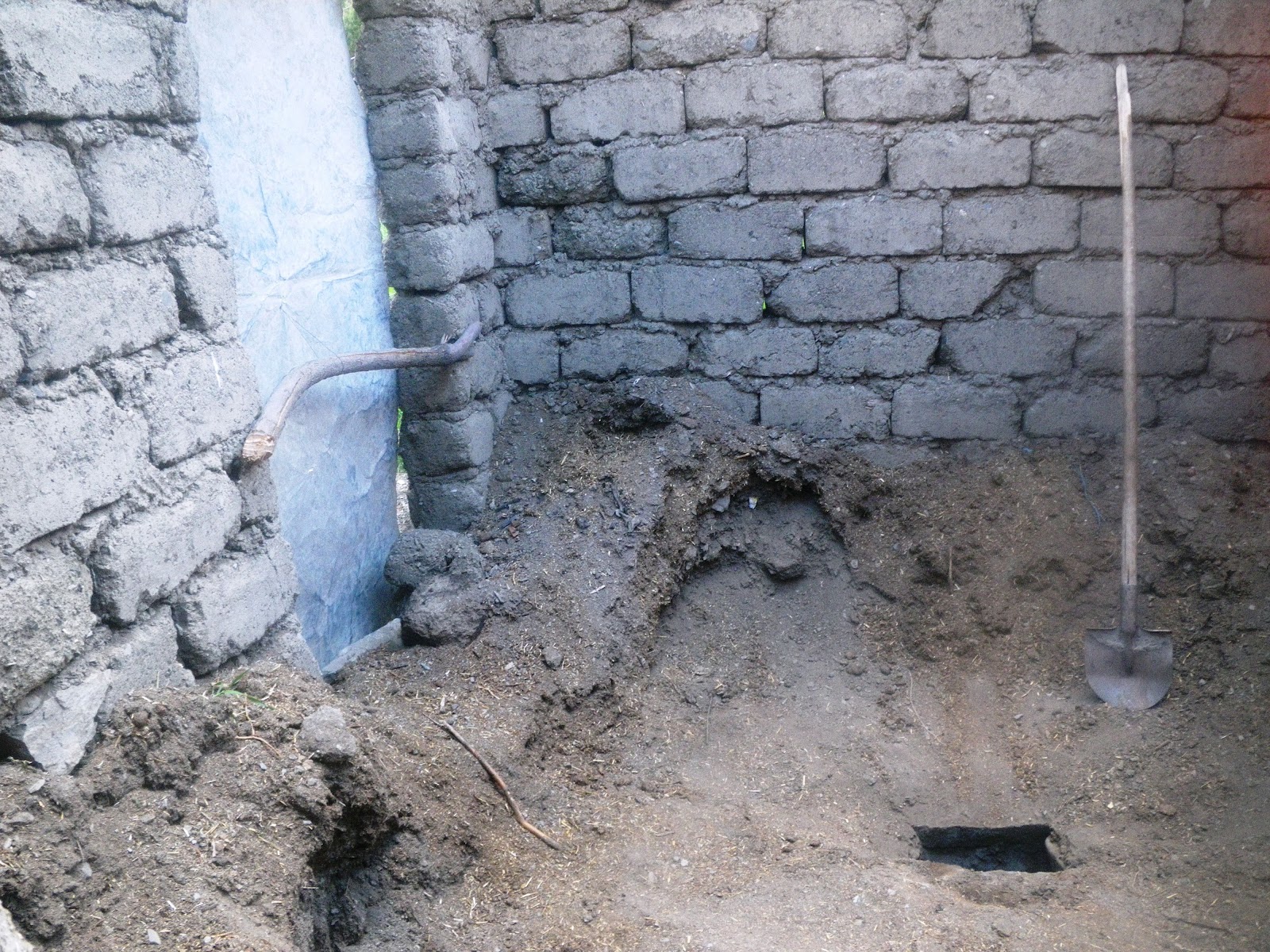
went up to use the toilet, we all came down with the same happy exclamations.
It was a traditionally Ledakhi toilet, in the open air on the roof. Just a hole
in the floor, a spade and some composting dirt all in the open air, getting some
fresh breeze on your bits!
 |
| Our toilet |
The next morning on waking up we were able to view the full
beauty of the village in the bright sunlight. There were only around thirty residents,
and we counted about ten houses. They were set in the valley up slopes, each
with their own patch of bright green barley growing on rice paddy ledges, with
the beautiful sparkling clean mountain river flowing through. We explored the
place, waving and shouting ‘Julay’ to anyone we saw. They were very interested
in us, and the only two small children we saw in the whole place were too
scared to come out the front door to inspect us. It felt as if we had wandered
into a time machine and come out in a Himalayan village of 200 years ago. There
was no electricity, no running water, no roads or machines at all that we could
see. The farming was done by hand, as was any other labouring, including carrying
heavy rocks to make irrigation channels and build walls. We saw old ladies
carrying huge loads of rocks in baskets held by ropes across their forehead. We
wandered around the village in bliss, in awe. No sign of modern civilisation to
be seen. It was like we had found Shangri La.


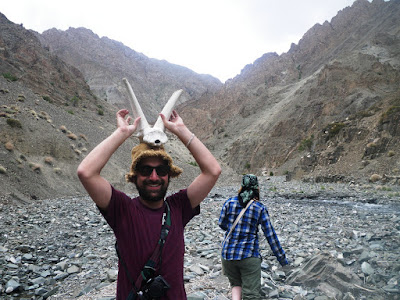


We spent four wonderful days there, climbing the surrounding
mountains and walking into the deserted valley, where every now and again we’d
bump into a cattle herder or little old ladies outside their mountain houses,
tending to the tiny goats. The valley was a green oasis, surrounded by big
brown rocky mountains. At night we’d sit on the roof of the house, staring at
the immense number of bright starts, it was like stars had been spray painted
across the sky, making it a silver blanket instead of the sparse hazy specks
you get in cities and towns. All the village people popped their heads in to
inspect us; it was clearly an event to have four foreigners in their tiny
community. They all tried to talk to us as much as they could with small
amounts of English, although it usually ended up as ‘Julay Julay!’ from both
sides.
 |
| Village neighbour sticking his head in the window to investigate the foreigners |
I drank water straight out of the pipe coming from the stream, and it
was delicious and clean and I didn’t feel the faintest bit ill. The other’s had
purification tablets which is usually a good idea. I also had my filtering
straw which meant that when we went for walks I could drink straight out the
river, although I’m not sure I needed it.
One afternoon Ido, Vincent and I climbed to up one of the mountains
overlooking the village and the view nearly almost brought tears of joy to my
eyes. We did a bit of slightly hair raising climbing too, actual Spiderman
moves up vertical rocks until we got to a point where we couldn’t really carry
on, plus the way down looked slightly more scary (it’s easier to go up than
down when its near vertical) and so we reluctantly climbed back down again. It
was such exhilarating fun, I will never forget it.
 |
| The best view of the village after our big climb |
Every day Pulma made us a totally different, absolutely fresh and delicious vegetarian meal for breakfast lunch and
dinner, I wish I could remember the names but after those four days I felt
healthier than I had in years. Gayla also had a ukulele with her almost exactly
like mine, and we learnt some songs together like The Fleet Foxes which have
been stuck in my head ever since. We had to bath in the river one hot
afternoon, the water was freezing and clean and makes you feel more fresh and
awake than you’ve ever felt. One night after dinner, Pulma put some music on
her phone and we did some dancing around the candlelit room, Pulma and I and
then Vince breaking out his ballroom moves. They had friends staying with them
one night too, a Nepali couple that had come to Ledakh to work. Papa would
always sit in his corner, spinning his prayer wheel and learning English out
his book. Every now and again I’d read along with him and tried communicating
small bits of conversation through the book, and he would always break out in
his cute chuckles, grinning serenely at us all.
Walking in the amazing valley, reading, playing music, going
outside in the pitch blackness to look at the stars and feeling lost from the
modern world and detached from civilisation completely, words cannot describe the
happiness. When it was time to leave, they still didn’t even mention money. We
ended up giving them Rs1000 each, which I think was quite a lot for them but
really was hardly anything for us. The experience and what they gave us was
worth ten times more than any five star hotel in any resort in the world as far
as I’m concerned. The granny we met on the first day insisted we went to her
house on the way out the village for some tea, and even gave us a little
goodbye dance with some music she put on. Her son worked in a company in Africa
I think, and had a new wife and baby. She told us he was going to visit very
soon.
We were all very sad to leave, and I definitely left a big
chunk of my heart there. A pure, beautiful place. I’ll never, ever forget it.
On the way walking back, we stopped in a glade for some coffee out Ido’s pot,
and the valley filled with goats, cows and sheep. The family shepherding them
waved us goodbye. Getting to the bridge where we saw the road was hard...
people! Civilisation! We waited for a bus in a small cafe on the roadside,
drinking sugar laced Mountain Dew. Then, who do you think appeared waiting for
the same bus? Papa! He was heading to Leh a few hours away to go to the doctor
for his bad knee. We sat with him until a packed bus appeared, and he bustled
inside followed by Gayla, while three of us were told to go on top of the roof
of the bus with all the bags and packages and teenage boys. Okay! Such a crazy
awesome ride back, the bus twisting and winding around the epic mountain passes
with fresh wind in our faces and a brilliant view of the mountain scenery. The
boys there all thought it was hilarious that I was on the top bus, and
eventually stopped looking and settled down to get as comfortable as they could
amongst all the packages. At one point, some villagers hailed the bus and
started hurtling huge baskets and packages on top, as well as a big metal
ladder with a huge metal spike sticking out the bottom, inches from our heads.
We had to clutch onto the ladder and put my bag under the spike in case it
jolted over a pothole and speared us. In this way we went the few hours to Leh,
and just outside the town the conductor made us get off the top ( I guess it
was illegal) and squeeze, literally squeeze all our internal organs, into an
already packed bus. The top is definitely the better place to be.
 |
| Top of the bus |
Papa got off
and gave one more handshake and chuckle, and then was gone. He really did touch
my heart, the sweet man.
 |
| Papa and I |
Back in Leh, we found that the place was filling up with
more tourists because it was getting to high season. We searched and found a
guesthouse with a balcony view, and stayed there two nights. The plan was to go
south to Manali, and Ido, Gayla and I were going to splash out and get a
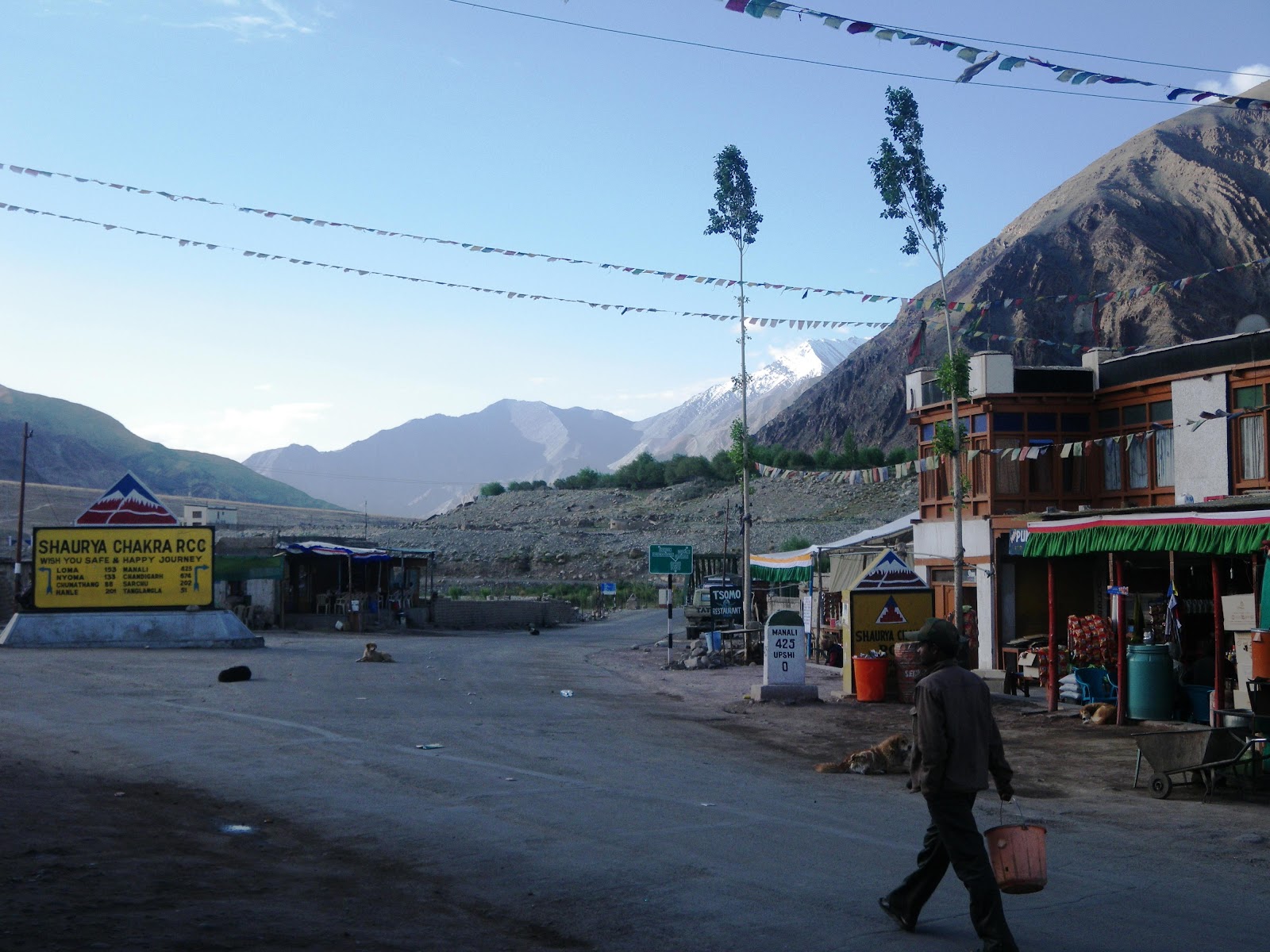
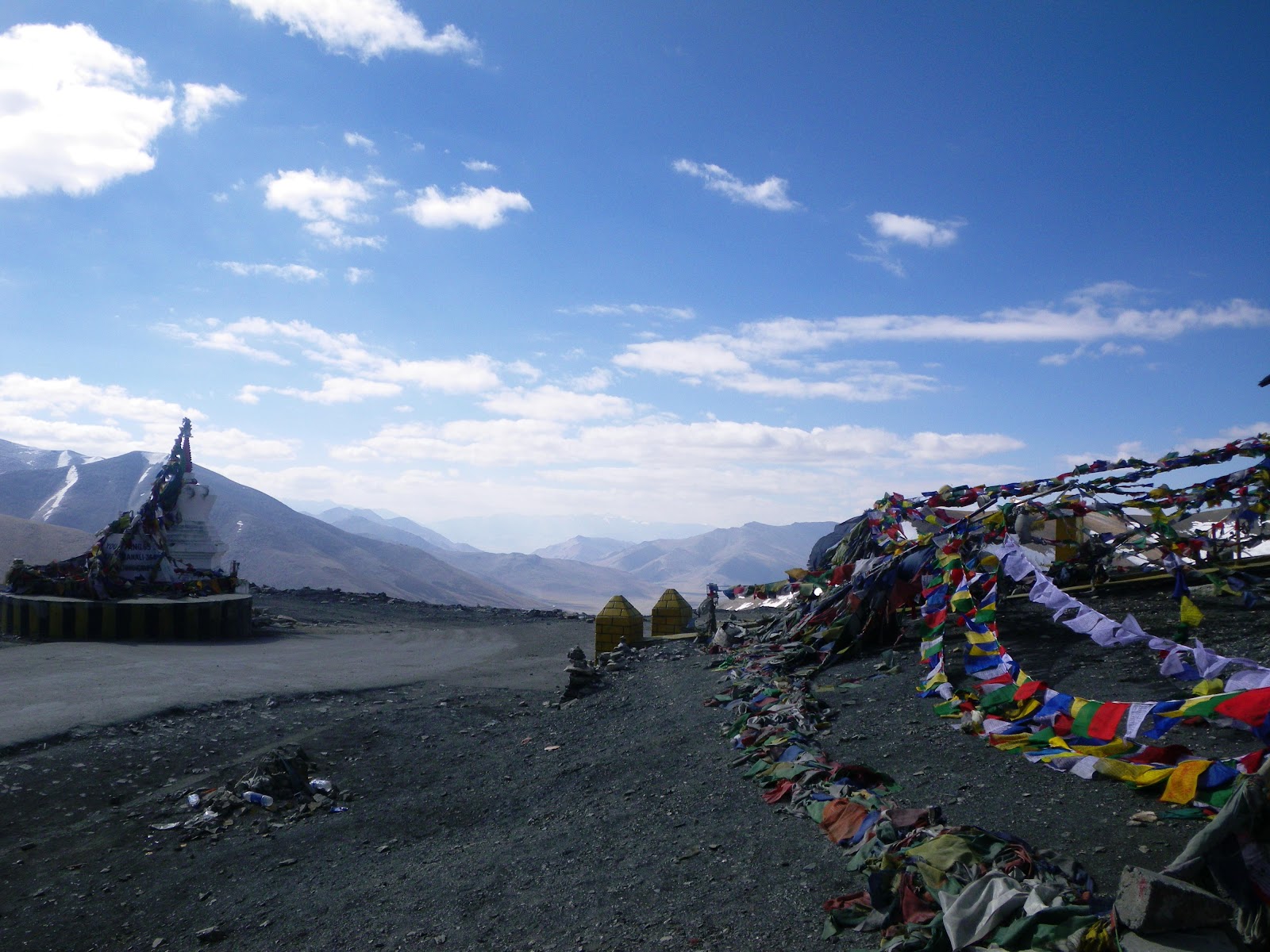
private jeep. It was a long journey through the second highest mountain pass in
the world, and we really didn’t have time for the arduous local bus ride of
more than twenty three hours.
Thank you Ledakh and the Himalayas for one of the most
memorable and inspiring experiences of my trip. The people, the landscape, the
food, the altitude, the air, all of it sublime. Time for one of the most epic,
overland road mountain journeys ever. To Manali...