Ido, Gayla and I left Manali for Kasol
early in the morning in pouring monsoon rain. A friend of Ido was coming with
us too, Lio who is French and an artist. We organised a tourist bus through an
agency in Vishisht, Rs400 which was expensive for the four hour journey (only
76km, but in India that equals four hours) but it was supposed to be a more
comfortable, fast and direct saving us around three buses, so okay. We got down
to the bus station in New Manali and waded through the roads that were now
rivers to find a daba for tea and chapatti before our bus. The minivan was
quite comfortable, but stopped at a pashmina scarf shop where we all just
stared at each other and didn’t get out, obviously they think tourists paying a
bit more for a minivan instead of local bus would want to buy stuff but the
minivan was full of Indian’s, we were the only tourists. It also stopped at a
stupid place for a tea, ridiculously expensive with all kinds of added charges
like tax and service added on in tiny print. It’s called Himalayan Village and
it has a beautiful garden and luxury treehouses that you can stay in nestled in
the forest. But a cup of black tea was Rs40 while everywhere else it’s around
Rs6. One of the waiters told Gayla the price of the tea, then brought her
something different that was more expensive without telling her. When she
refused to pay the more expensive price the manager chased her outside and
started yelling at her and would not let us leave until she paid the Rs10
difference, in front of all the other customers. Honestly a pathetic and
aggressive way to behave, so avoid that horrible tourist trap at all costs. Himalayan Village Kasol.
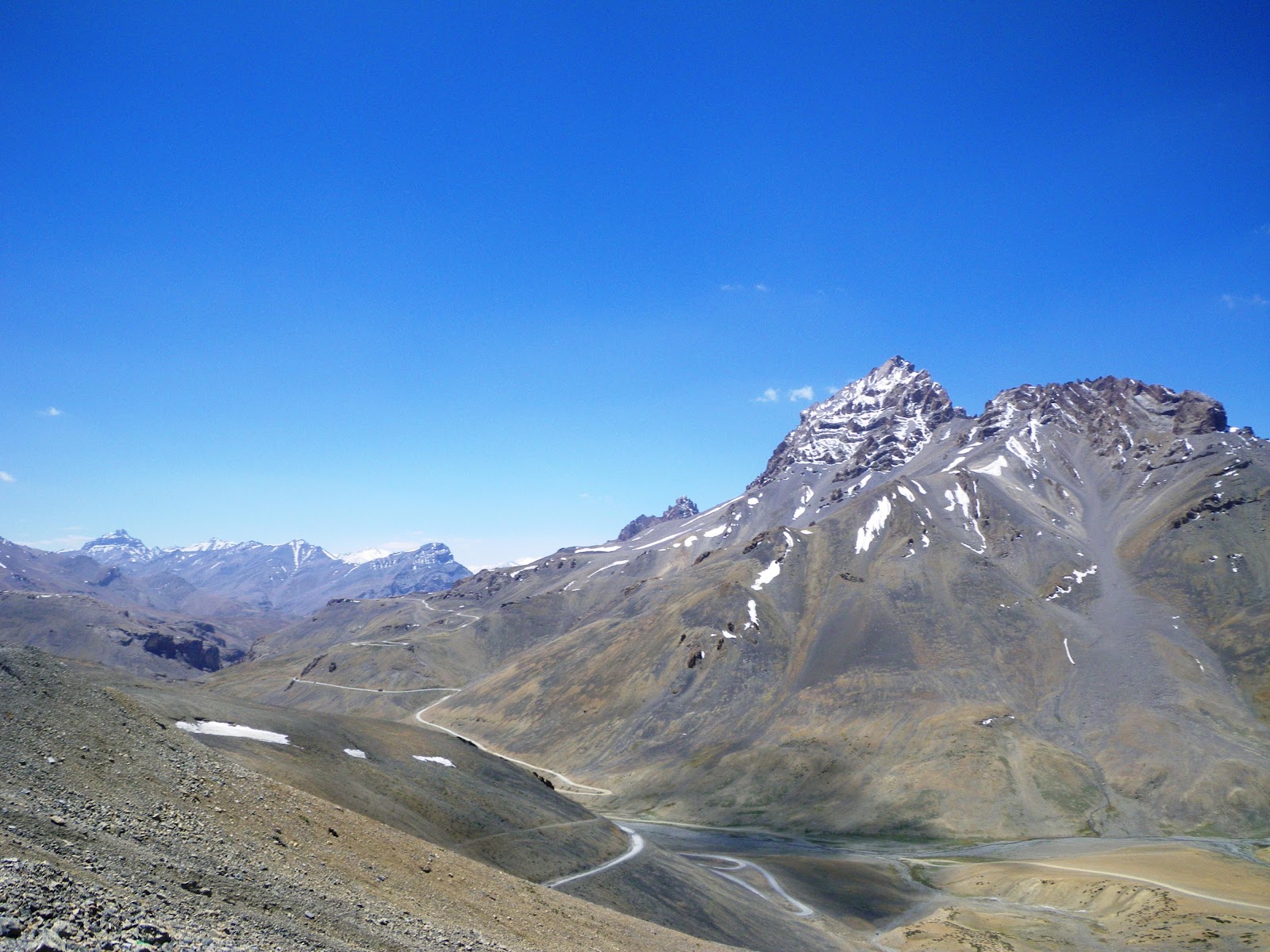
We weaved and winded our way
around the Parvati Valley
through forest and rivers. I’d never heard of Parvati Valley so I don’t think
it’s that well known to travellers, although it’s called little Israel because
Israeli’s flock there. One person must have told their friend about it, and so
on. I can’t believe it’s such a well kept secret. It’s a peaceful, beautiful,
mountainous forest valley with friendly people and nice places to stay. Kasol
is the main town in the valley, and from there you can take local buses to some
of the surrounding villages. There are lots of signs in Hebrew and Israeli food
in the restaurants, which is fine by me because it’s yum. The area has a big Tibetan
/ Nepali influence. We were still in Himachel Pradesh, North Western India
where many Nepali’s work and live, and so there was Nepali dabas (local
eateries) serving yummy momos
and thukpa, lots of vegetarian
and delicious food.
Ido had been here before and was still showing Gayla and me
around this part of the world. He went back to the same home he stayed in
before, what he called his Indian Mom, Nebula, and she is a very sweet lady.
She had really bad toothache when we arrived and had been chewing charas so she was a little
dazed. She had two cosy wooden upstairs rooms that she let out, with an outside
hot shower for only Rs100 a night (a little over £1) Downstairs she had a young
Nepali family as tenants, and their little boy was cute but a tyrant, shy at
first but after a while he grabbed onto my trousers with a nice gloopy ball of
snot in his hand. We wandered around the town eating momos, drinking yum masala
chai and looking at the Hebrew bookshops. I bought a really cool yak wool
waistcoat. It was low season, the town was practically empty. Everyone had gone
further north to Ledakh or Kashmir, where we had just come from. As I always
say, low season is the only time to travel. Everything is cheaper, the locals
have more time for you and aren’t so frantic and the weather is more
interesting.


 |
| Kasol |
The next morning we set off for
Pulga after eating shakshouka,
an Israeli breakfast of eggs cooked in tomato which I can now list as one of my
favourite breakfasts, to one of the tiny villages in the surrounding mountains.
The bus was Rs35 (£0.40) and took around two hours although it was probably
only around 10km. The road winding through the valley was now so familiar to
me. Gauged out like a ledge in the mountain side, it was more rocks and
potholes than a road that had never even heard about tar. The retro rocking
creaky bus flew over the jagged crevices and bounced us around like we were
being rolled down a hill in a metal hamster ball with wheels and seats. The bus
was nearly empty too with only a few locals, including a sweet little baby who
sat up and was bounced around with a smile on his face throughout. There was a
man with his young son, who every so often would discreetly stick his head out
the window and vomit a little, and then go back to sitting obediently next to
his father. Can you imagine that happening in the West? Apparently because
these rural people hardly ever use transport they get car sick much easier than
we do, although I was feeling a little woozy from the rocking bus. I have a
video of us all bouncing around in a comical way.


 |
| Passing towns on the river in the valley |
We got to the end of the line
for the bus and had some chai and super fresh, melt in your mouth chapattis and
dhal with the flies in the daba next to the bus stop and set off for the hour
or so walk through the valley to Pulga. There are three small villages aligned
on three hills in this part of the valley and there is no road to them, you
need to climb through the valley to get there which makes them extra special.
Unfortunately they are building a huge hydro electricity plant in the river
that runs through the valley, and while it’s good that they’re using the
natural resource of the powerful water for energy it will ultimately change the
valley. But for now it’s still a beautiful secret spot in the middle of
Himachel Pradesh, a true North Western Indian village in the valley surrounded
by forests, rivers, and mountains.


School girls with red ribbons in
their plaited hair walked along us on the path to their village, pointing out
the way for us. Herds of small packhorses and their herdsmen also wound through
the narrow path and as they passed we had to find a place to perch out the way,
making sure we didn’t fall down the steep valley. (I did fall once like an
idiot when a man carrying a hay bale walked pass, but luckily a bush caught me
otherwise I’d be at the bottom of the ravine).


It was a beautiful, sunny day so
we arrived sweaty and happy to a place where Ido had stayed before, Devraj
Guesthouse. It is a three story wooden house with eight rooms right at the edge
of the village, surrounded by yellow wheat fields and looking out over two mountains
converging into the valley between which the sun set, all surrounded by a fresh
green pine forest and snow tipped mountains in the distance. There was a mouse
quiet German guy in one room called Ben who had been there for a few weeks, and
an even quieter, gentle, long haired Japanese hippy guy in the other room and
then us. After a few days, two more Israeli girls arrived and painted a black
and silver bird on the wall at the top of the house where the sun streamed in
and there were hammocks to watch the sunset. Lio also set to work as soon as we
got there to paint a cool design on another wall in the open upstairs sunset
drenched spot.


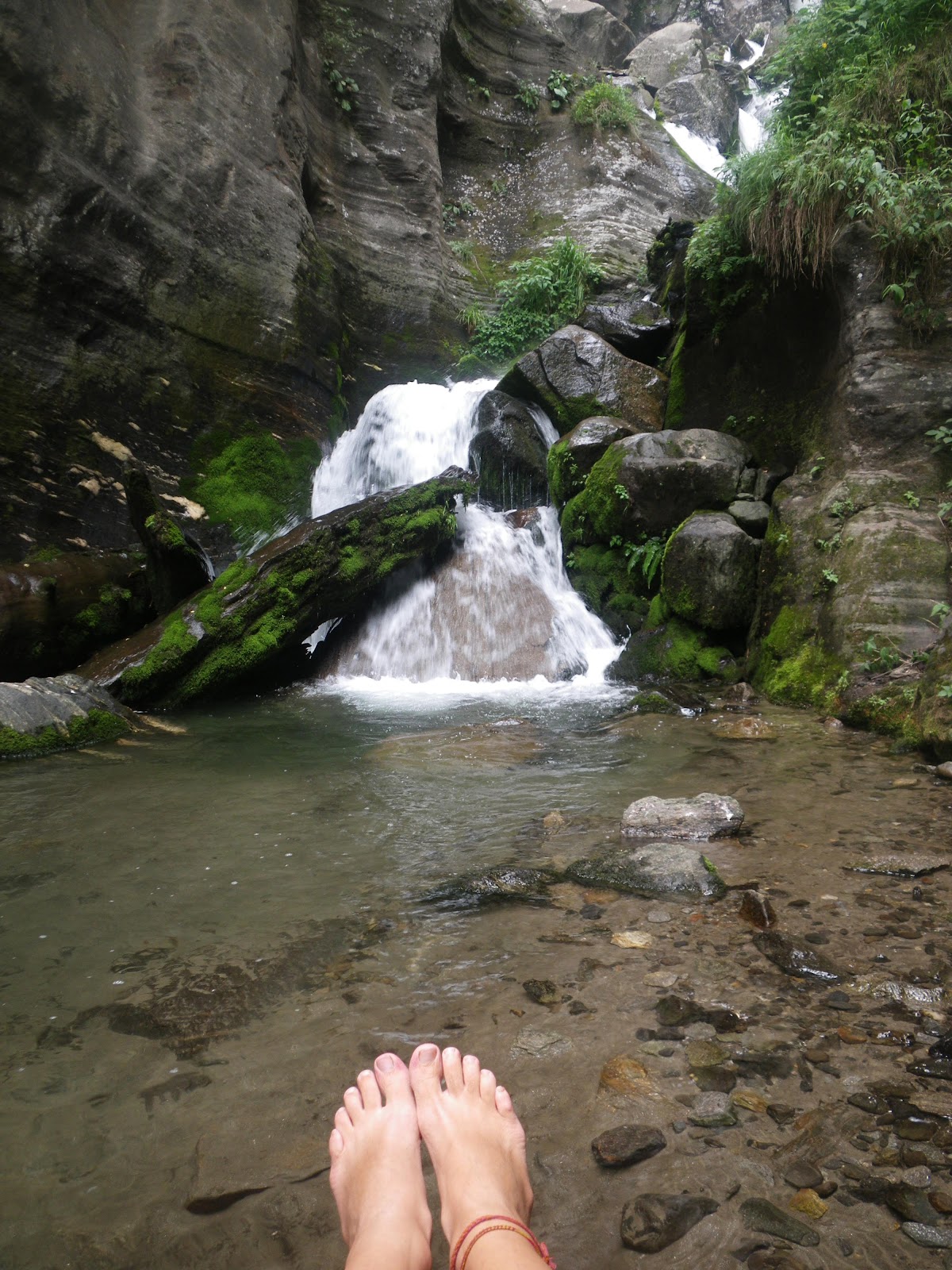
We spent five days there, watching
the sunsets, playing chess with Devraj, going into the forest (nicknamed the
Fairy Forest) and soaking up the magic spiritually of the valley. If you
carried on walking up, you would walk into the Himalayas and not see another
village and probably not stop until you reached the top of a 5000m snow tipped
peak. One day when running around the forest, some nomadic looking mountain
people with baskets on their backs held up with a strap over their heads in the
typical way they carry heavy packs, came and sat with us just to have a look as
no communication with words was possible. Village dogs in packs would bound up
the mountain to sniff at us and hang out jostling and playing until they ran
off in a frenzy back down the mountainside.


We ate fresh yummy food at Devraj’s
restaurant nearly every day. Fresh ginger and lemon tea, masala chai, vegetable
thali’s, oats with apple, Israeli salad, spicy dhal and rice and sometimes even
chocolate cake or quiche.


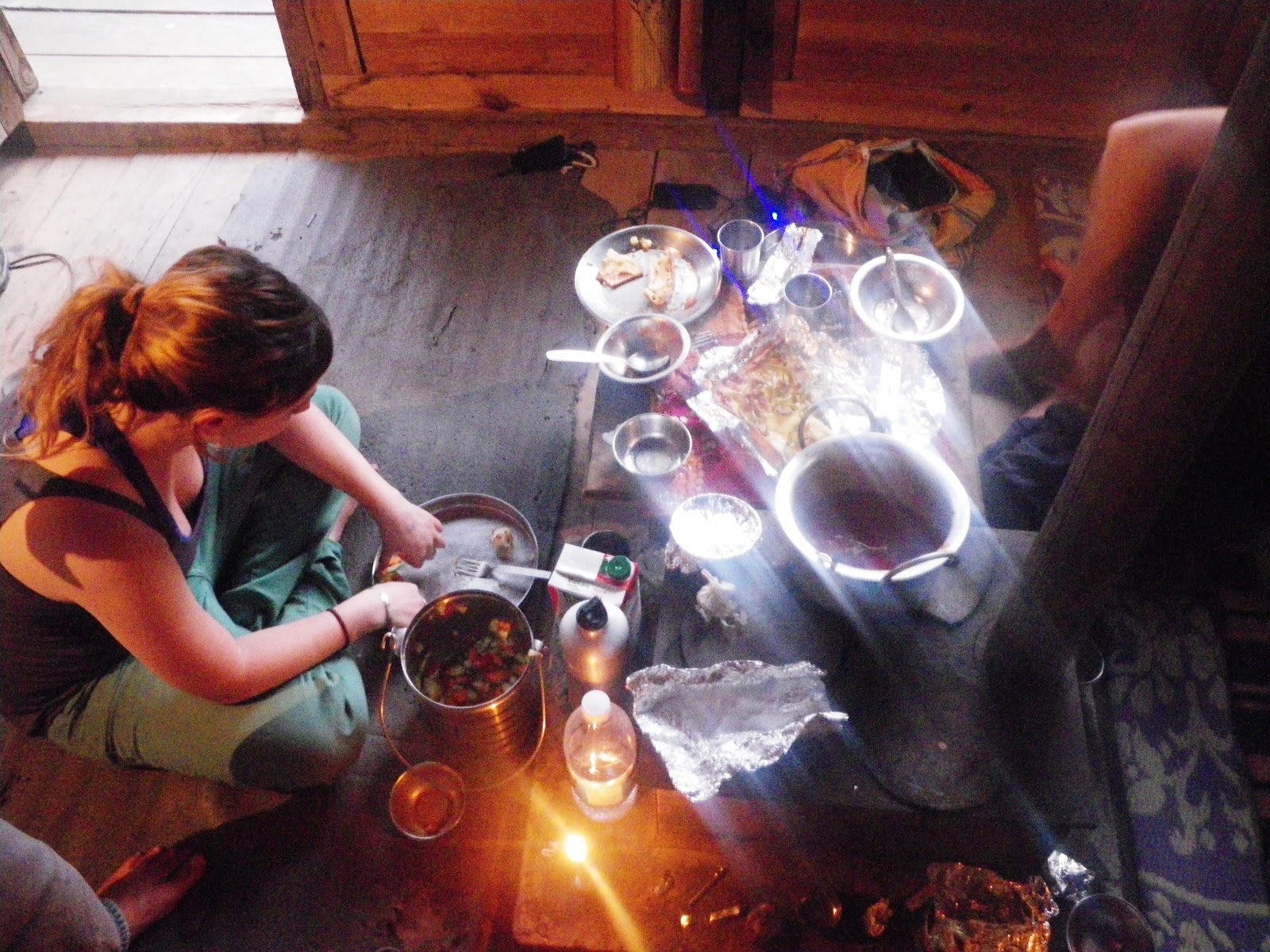
One Friday we decided to try cook
in the small kitchen shack outside Devraj’s guesthouse, and bought all the
ingredients from the tiny local shopkeeper. We made tomato soup, crumbed cauliflower;
salad and Lio went to the kitchen at Devraj’s restaurant and made two really
delicious quiches in the wood oven. It cost loads more than just eating at the
restaurant where a whole meal is around £1, but made for a really fun day of
activity as none of us had cooked for weeks or months and we missed it.


One afternoon we walked to one of
the other villages on the opposite hill in the sweaty heat and had ice cold
sprite and apple juice from a local shopkeeper, with his tiny granddaughter
watching on. This really was low season, there were nobody around this village
except a few local men sitting in groups under trees talking together. On
returning to our village we each dumped a bucket of cold water over us (our
shower) and sat against the wall of the house in the rays of the setting sun to
dry off. It was five days of living in a
secluded, mountainous, fresh forested North Indian village, and I couldn’t have
been more in tune with myself, relaxed and happy. Ido, Gayla and Lio were all such
great people to spend time with too, they really made the experience.
The three of us decided to go to Dharamshala after Parvati, also
in Himachel Pradesh. I needed to stick to the area between Leh and Delhi as I
only had a month in total, so Dharamshala was a perfect place to end my trip.
It’s where the Tibetan parliament now is and has been for the past 60 years. How
grateful we should be to India for housing the exiled Tibetan government.
From Kasol it’s an hour and a half
bus local bus ride to Bhuntar (Rs25) where I got lots of uninhibited stares
from the local men. As usual, there were way more men everywhere, on the buses,
on the streets. Bhuntar isn’t anything special, just another busy dirty town. I
bought two juicy yellow peaches like the ones you get in South Africa at a
fruit stand and munched those. We had to wait a couple of hours eating Indian
sweets and drinking sweet chai in Bhuntar, and then got onto an overnight
tourist bus to Dharamshala for Rs500.


The bus was comfortable and packed with
tourists coming from Manali, but we had to sit right at the back which always
equalled the most bumpy and stomach lurching ride (I had learnt this all the
way back in Vietnam).This was my first night bus in India and I was a little
terrified, I’d seen the roads in the day and they didn’t fill me with
confidence. The driving was absolutely mental too, but somehow it all worked
and flowed and I hadn’t seen even one accident, I knew you just had to relax
and meditate your anxiety away and trust Shiva that it would all be fine! We
stopped for some chai around midnight and had some fresh ginger and lemon, and
then got back on the bus for the night. I somehow managed to doze off but then
was lurched awake in a cold sweat. The driver was careening down the
mountainside and taking the twists and turns so fast that I’ve never felt such
sickness, and had to stick my head out the window only to see the road and the
cliffs and the bus lurching left and right. He was driving like a maniac, and
this was the only time in all my travels that I felt genuinely afraid. Ido and
I were bouncing up and down in our seats so much that our heads practically
were touching the ceiling. He was my hero though, and as soon as he saw how
terrible I felt he marched straight up to the front booth where the driver was.
He walked inside, and I couldn’t see them but the driver was so surprised he
screeched to a halt to hear what Ido had to say. I heard him say loudly in
surprise: ‘SLOWER??’ But when he started up again he did actually go slower
which totally amazed me, all the way to Dharamshala. Thanks God! Ido told me a
few days later that he thinks the driver was drunk, but he didn’t tell me at
the time which I was so grateful for.
Dharamshala is another pretty,
green mountainous town in Himachel Pradesh. One thing it’s popular for is
classes for tourists, like jewellery making, cooking, yoga, meditation and
Indian instrument making or playing. There are a couple of areas to stay but
the main ones are at the top on a hill, Bhagsu and Dharamkot. Bhagsu is
described as a commercialised warren of concrete which I have to agree with,
but is also where most of the classes are and is central and easy to get
around. Dharamkot is a little further up the mountainside than Bhagsu, there
are no roads there so you have to make a little walk through the rocky pathways
but it’s worth it, its green and quieter and just nicer. I ended up staying in
Bhagsu though, up the hill in a guesthouse with a really nice balcony and view
of the valley for Rs250. It was a big clean room with a really nice bathroom
which I’m sure in peak season would be more like Rs400 a night. They had nice
food and coffee in Bhagsu, and it was a shorter walk to Mcleod Ganj down the
hill which is home to the Tibetan community and the main tourist hub, and also
some good local dabas. The Tibetan influence gives Dharamshala a feel of
multiculturalism and is a perfect example of India’s tolerance. Hindus and
Buddhists live harmoniously side by side which gives the city a peaceful,
colourful serenity. We watch school children play from a balcony, running as
soon as the bell rings to their classes and a stern looking teacher marches to
the class holding some kind of instrument, while a monk reads on a rooftop
nearby.


The traffic is nuts, with cars,
bikes, rickshaws, tourists all trying to squeeze down the same tiny roads, with
Tibetan ladies selling their jewellery all along the sides. Every afternoon a
downpour of fat heavy droplets would tumble out the sky drenching everyone,
making the traffic thicker and the people wider with their umbrellas, which
they use for the sun as well as the rain. Tourists are very common here, but
even so a Sheikh man held up
his baby to look at me as I pass. I wave at the baby and his little face
contorted into an expression I couldn’t make out.
We walk down the hill to try find
the Tibetan museum, which is actually in Mcleod Ganj and not hard to find but
somehow we missed it. We walked down and down into the valley, and came across
a restaurant and book shop that looked like it could be in Primrose Hill,
London. It couldn’t be more different to its surroundings, but it was a welcome
place to step into. Called Cafe Illiterati, it was decorated by heavy stone floors and wooden
furniture, walls of rare and interesting books along with classics, and books
on every subject. A small but delicious menu, on the expensive side but the
food was so good. And musical instruments dotted around the place with couches
to read on and fresh mint lemonade to drink. We walked around, touching the
books and looking at everything that was so different to where we were. The
owner was from Belgium but spoke fluent Hindi, books was his passion and he
spent his free time in markets searching for them. We decided to go back there
for dinner, and continued the search for the Tibetan museum. When we did go
back I bought two books, Kafka and a really cool book on Victorian trades, with
Victorian illustrations. He said it took him ages to find that one, and was sad
to see it go.


On continuing we realised we had
gone too far, we found ourselves in the Tibetan Parliamentary houses. There was
the Department of Information and International Relations, Library of Tibetan
Works and Archives and many more. The people were in traditional Tibetan formal
clothing, walking purposefully around during their working day. The older
generation of Tibetans sat on the steps of the buildings, talking and the women
looking after grandchildren.


In Bhagsu, I really wanted to learn how to
make Henna tattoos, learn Bollywood dancing and to cook some Indian food. It
was down season, and so not many classes to choose from. Bollywood dancing, I
was told, was in Mumbai where Westerners were coveted as extras in those big
colourful Bollywood productions. I’d have to leave that to another time. I
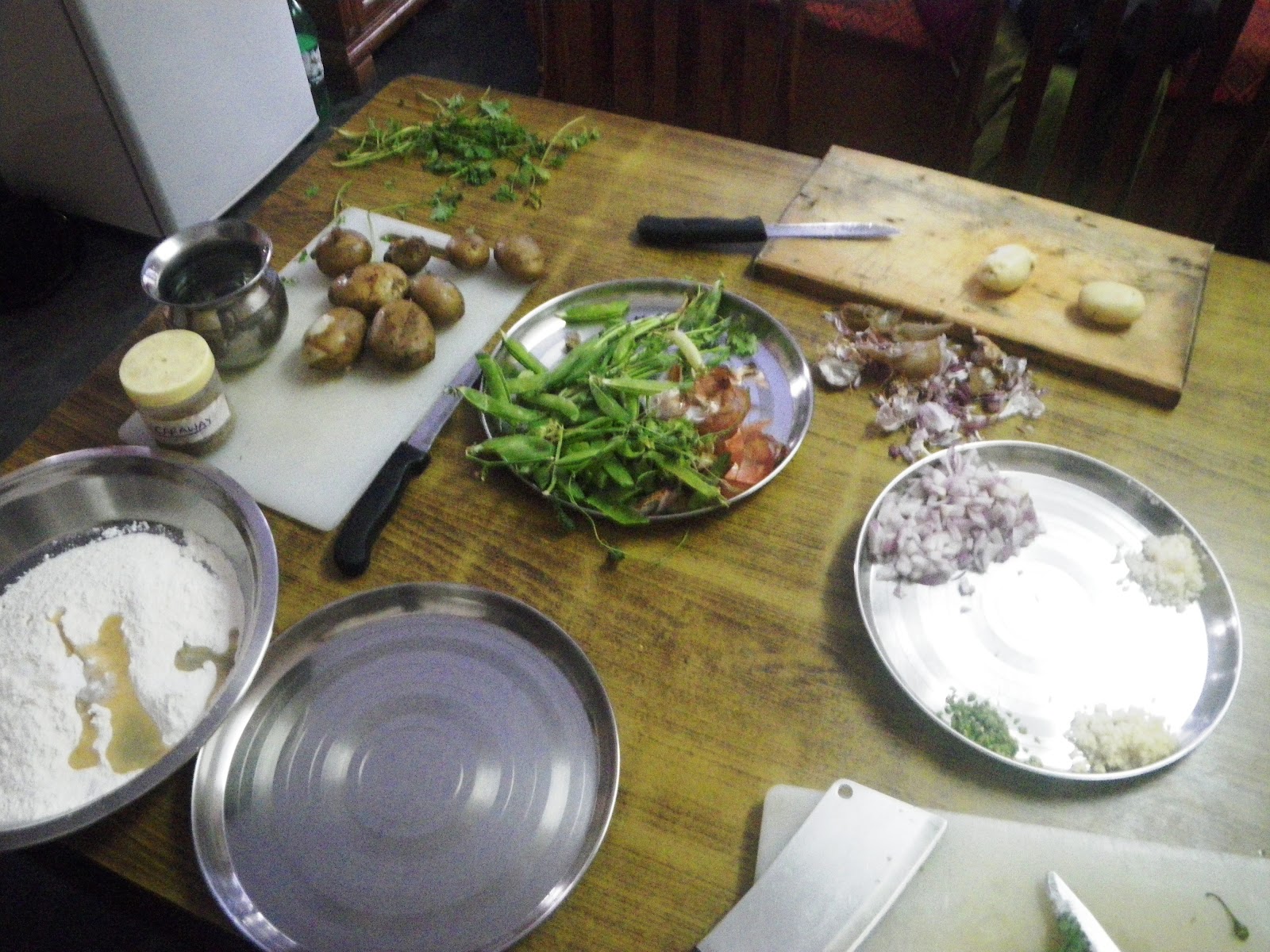
found Rita’s cooking school, where one morning she taught me how to make spicy
dhal and samosas, simple delicious vegetarian food which I’m hooked on.
Ingredients like chilli, garlic, potato, coriander seeds, lentils, onion. YUM. It
cost Rs300 and you get to eat for lunch what you just made. Rita was a ‘no
nonsense’ Hindu lady, a clever businesswomen and a busy mom, she sang mantras
while she cooked.


After four days it was time to
make my way back to Delhi to leave India. I bought an expensive overnight bus
ticket, I wanted to make sure the horrible night bus experience wasn’t
repeated. And this time I sat in the front. It cost Rs1100 from Dharamshala to
Delhi, leaving at 6pm and was twelve hours. We were still up in the mountains
and had to wind down to the low lying Delhi, so the roads were windy and twisty
along green rocky valleys for the first part, and then flat and straight
towards the end. The bus driver drove sanely, although stopped every hour for
unknown reasons (to smoke, pee, chat to a friend?) and played music and
Bollywood movies all night with the lights blaring. I’m not sure India has got
the hang of the meaning ‘sleeper bus’. I got to Delhi at 5am where the bus
dropped us off somewhere outside of town on a dark highway. There were
rickshaws and taxi’s waiting, I felt more confident this time in Delhi after my
four weeks in India. I negotiated the rickshaw’s price and we drove through the
already hot, still dark early morning streets of Delhi. I wondered what the
piles were on every street corner or just dotted around the highways, and
realised they were sleeping bodies which looked like they were dead. Just
sprawled out everywhere and anywhere, no covers, half naked, distorted into
strange positions and not even lying on newspaper or cardboard, as if they had
just collapsed where they were standing. My rickshaw couldn’t find the
guesthouse I wanted for ages, and drove me round and round the Main Bazaar so I
could watch the sun and people rise, showing up the dark piles to be either
rubbish, cows or more sleeping bodies. Within minutes it felt like, everything
was awake and humming with people, cars, heat, animals, stalls, fruit, rubbish,
smells, smoke, pushing, sweating.
Eventually we found Hare
Rama Guesthouse in the Main Bazaar down an alleyway off the main street.
It’s Rs500 for an air-conditioned room with a bathroom. I’d recommend it too,
its central and good value for Delhi and the staff are friendly. There is
another guesthouse opposite with a restaurant and wifi. Delhi was hot, a heavy
compressed heat that sticks and weighs you down, air-con is a must although
usually I hate it. The only window in the room is tiny and painted black, when
I open it a group of pigeons squawk and flurry and I look out at an air-con
unit humming and a poky alleyway, and the dirty air pours in. I close the
window, and go to sleep. My flight is the next morning so I have one full day
and night in Delhi so I decide to go out to look at the Main Bazaar and Connaught
Square. Its low season now and a Sunday, so while there are still some shops
open in the Main Bazaar, Connaught Square is dead, most of the shops are
boarded up anyway and look deserted. Every ten minutes a man
approaches...’where are from, can I help you, let’s chat’ and won’t leave me
alone until I get angry. These aren’t just friendly locals, I’ve been warned to
avoid people wanting to ‘practice their English’ especially if they approach in
a tourist area and aggressively won’t leave you alone. I get tired of this, I
like to trust people and I do in towns and villages but not in the main tourist
area in Delhi. After walking for a couple of hours the heat, dirt and attention
became too much for me and I get a rickshaw back to the hotel. In the Main
Bazaar, shopkeepers lazily call out to me as I pass, in low season they don’t
have the urgency for you to visit their shop. Some even ignore me, which is a
welcome break. I buy a scarf, an anklet and a really nice leather jacket from
Sheikh’s Leather Shop after trying on about a hundred, it cost me £40 with a
leather wallet. I spend the rest of the hot afternoon writing and sweltering in
the guesthouse, and then took an evening stroll through the winding tiny
alleyways of the Main Bazaar, no peeking necessary into the lives of the people
there as they live so openly in the gutters and alleys. Washing, eating, sleeping,
scratching, children doing homework, men watching their shop wares squashed
into their tiny spaces. I get some stares, but they are used to tourists so not
too many. I eat my last delicious spicy vegetable thali in a daba. Cheap,
fresh, I’ve forgotten European hygiene requirements; these are the best places
to eat. Forget restaurants for tourists with old food and empty seats.

 |
| Deserted Connaught Place |
A full day and night in Delhi is
enough for me, I’m glad to take the taxi to the airport the next morning. There
was a festival on, I think Maha Shivaratri, and the roads are packed. There is
a Mahasivarathri procession
on the highway, men all dressed in orange carrying huge colourful pyramids
which they will burn later.

I make it to the airport with just enough time to
check in and get to my gate (as usual, not leaving time to spare) and start
reading about Nepal. This is my time usually to open my guidebook for the next
country, waiting for the plane. It’s exciting, I don’t know much about the
place, where I’m headed exactly or what I’m going to do there, only just before
the plane leaves discovering and deciding for the first time. I look up the key
phrases, hello, thank you. I can’t wait for Nepal and more Himalayas, mountains
are always where I’m happiest, and I’ve only heard wonderful things about the
place.
I was only in India for four
weeks. I didn’t see the Taj Mahal, Varanasi, or even the Ganges River. I went
straight up into the North Western Indian Himalayas and found exactly what I
was hoping for when I planned to go to Tibet, although I probably wouldn’t have
found it there in the China-choked dictatorship of the region. I saw epic,
staggeringly vast desert mountain ranges and beautiful, secluded Buddhist
mountain villages where I could drink fresh mountain water straight out the
streams. I had more mountains than I could devour huge valleys of powerful
rivers, dense green forests that went on forever to the top of snow tipped
mountains. I met hippies, Buddhists, Sheikhs, Hindu’s, travellers, the poorest
people without even a rag to cover their backs, middle class families and the
rich shopping in designer shops in Delhi. I ate in restaurants, dabas, food
stalls, corn on the cob covered in lime and salt from shrivelled old ladies
roasting them over a fire on the floor on the street. I was on buses, cars,
planes, staying in guesthouses, on mats on the floor, with families in the
rooms they let out. I got stared at, but with a smile and confidence everyone
is your friend and will help you with anything. I saw a religious broth,
temples, festivals, rituals all performed in harmonious tolerance of each
other. India is modern, ancient, colourful... religious, friendly,
otherworldly... happy, heart wrenching, fragrant, forgiving and unforgiving. I loved it and I will definitely be back
there again. And all of this I wouldn’t have seen if I had originally gone to
Tibet as planned so let’s hear it for Plan B.